Which is Better? Online vs. Print Advertising

Advert Spending By Media Type
Source: OnlineMarketingTrends.com — As Projected for 2015 & 2016

“So, which is better, online or traditional advertising?”

A client recently asked me just that question.  The answer, however, is not as straightforward as you might think.  So in a twist of tradition, here is the ‘meat’ of my answer: “Advertising success depends on two factors:

  1. Who is the target?
    and
  2. What are your goals?”

Let’s break down these two components…

Who is the advertising target?

Often overlooked, ‘knowing your target’ is a crucial piece of an effective sale conversion strategy.

“Everyone should want to buy my [widget/service]!”, a client told me once; and while potentially true, research shows that timing & relevance are a much bigger factor in making a buying decision. Crucial pieces of effective sale conversion strategy rely on saying the right message at the right time. As such, knowing your target and their buying cycles tends to lead to a significant lift in success when it comes to any advertising.

Demographics are a huge aspect of knowing your target

Today’s ability to track age, gender, location, how they saw your advert, how long they stayed, did they share it, etc., are at the core of the advantage of digital advertising. In fact, “Direct Response Marketing” techniques are heavily invested shopper data in an effort to ‘personalize’ the shopping experience for each individual.

Advertising GoalsWhat are your advertising goals?

Today’s goals seem different, but they’re not. In fact, the goals have not changed until the last 20 years. It is still all about the conversion of the audience or “target” — are you seeing the tie into the first advertising component above?

So, what did traditional advertising discover that digital ads still need to work on?

In short, ‘message effectiveness’. Tradition advertisers recognize that the timing at which their ads display — and the core of the offer — must be in alignment with the awareness level of the target. While simple messages like “free trial” and “try it now” are synonymous with today’s advertising, traditional adverts, traditional methodologies tend to focus on an awareness level that works off the brand awareness level — and consequentially, the true reason people buy — how the experience made them feel.

Today’s conclusion to this deep advertising question

I could probably write 10 more blogs on this subject and only scratch the surface, but the bottom line is, both types have their place. A wise marketing mentor taught me a lesson that I will never forget: “Never put all your eggs in one basket!”.

Message From The President — June 2017

This Month’s Topic: “What is the #1 plan to create content?”

President’s Message for June 2017

Make A Business Plan Life CycleI cannot remember ever being a fan of doing anything that does not have a clearly defined methodology and plan — it is just my nature.

It is my belief that without a plan, not only will your execution be scattered, so will your results.

This is not to say that I was not horrifyingly bad at writing content, I just did not understand how important the nuances of the plan are.

Kitty WarriorDON’T GET STUCK IN ONE MODE
The plan to do something — anything — is a double-edged sword. You ultimately get driven by your successes and pushed down by your failures. This psychosis is a uniquely human paradigm as if an animal in nature hesitates or worries too much that its methodology is wrong, it goes hungry — at its core, survival is a matter of trial and error.

That said, the other side of that sword is, without the patience & due-diligence needed to create your overall plan, rushing through something without a plan can often be [its] undoing.

OH YEAH, THERE IS A PLAN — HAVE PATIENCE
So why am I talking about animals, isn’t this blog post supposed to be about having a content plan? It is, however, I propose that the more we can be in tune with the natural instincts contained within our human DNA, the better we can define and identify the methodologies that work best for each individual.

As such, it is well known that successful people make lists and within the bigger picture — and truth of the matter — is these lists are mini-plans.

Planning works in many ways, accurately presented in this quote from time-management-guide.com:

“Planning is one of the most important project management and time management techniques. Planning is preparing a sequence of action steps to achieve some specific goal. If you do it effectively, you can reduce much the necessary time and effort of achieving the goal. A plan is like a map.”

Okay, that’s nice, but what is the #1 way to create content?

Be the resource your customers really need!


8 Tips to help plan and make your copy easy to read:

  1. Use short paragraphs – four sentences max;
  2. Use short sentences – twelve words on average;
  3. Skip unnecessary words;
  4. Avoid professional jargon and use common/layman language;
  5. Avoid the passive tense
  6. Avoid needless repetition;
  7. Address your web visitors directly. Use the word “you”;
  8. Shorten your overall post-length — keep it 300 – 1000 words.

Here are a few links to get you started if you are stuck:

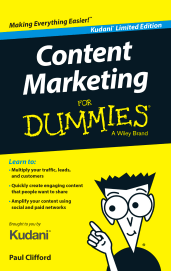
Content Marketing For DummiesGet this month’s free download: Content Marketing For Dummies” from Kudani.

PLEASE NOTE: In this book, take a look at the PICASSO content marketing framework created for use with KudaniCloud software. This share is not to sell you on KudaniCloud software.  I do not use KudaniCloud software and this share is not an endorsement of KudaniCloud software.

Words Matter — How A Single Word Makes All The Difference

Words That MatterYou likely know that specific words matter. You click on a headline because a single word strikes you.

What you may not know is, you click a call-to-action link or a signup button solely because a word creates relevance & emotion.

So really, how much do words matter?

The research behind this power of words is incredibly deep. Researchers have found that the word you use to describe a car accident (“contacted” vs. “smashed”) paints the way eyewitnesses view the event. Another study found that simple stock names that are easier to pronounce lead to quicker gains post-IPO.

Perhaps my favorite study is one shared by  Brian Clark of Copyblogger. Social psychologist Ellen Langer tested the power of a single word in an experiment where she asked to cut in line at a copy machine. She tried three different ways of asking:

“Excuse me, I have five pages. May I use the Xerox machine?” – 60% said OK

“Excuse me, I have five pages. May I use the Xerox machine because I’m in a rush?” – 94% said OK

“Excuse me, I have five pages. May I use the Xerox machine because I have to make some copies?” – 93% said OK

Words MatterI don’t know about you, but I thought Langer’s third request was rather elementary. Yet it didn’t matter. The trigger word “because” was all she needed. 

The takeaway: As single words matter, when you want people to take action, always give a reason using an influential word or phrase! 

FREE DOWNLOAD: Get “The 12 Most Influential Words In The English Language” — put together to help you chose the right words for your marketing copy — proven and guaranteed to get you better results!

error: Our content is protected — stealing is a crime — you are being watched!!